
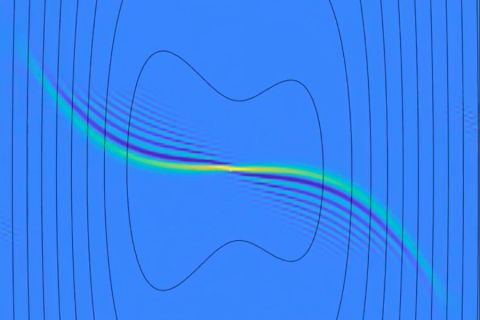
The vacuum is not always so empty. “When we talk about a vacuum in cosmology, we do not mean completely devoid of energy,” explains David Wands, Professor at the Institute of Cosmology & Gravitation at the University of Portsmouth. “A vacuum is rather a state in which a field sits at a minimum of its energy. The true vacuum is the lowest possible minimum, but there can also be local minima, which we call false vacua.”
We can picture this as a landscape made up of valleys of different depths: the true vacuum is the deepest one, while the others are false vacua. Something sitting in one of these depressions can remain “trapped” there even if, somewhere else, a lower-energy state exists.
This is exactly what can happen to quantum fields, fundamental physical objects that permeate the Universe. A classical field is something that has a value at every position in space, like a magnetic field, whose strength changes from point to point. Quantum fields behave in a similar way, and their excitations appear as particles.
In a new study published in JCAP, Robson Christie, Jaewoo Joo, Greg Kaplanek, Vincent Vennin and David Wands used a simplified model to investigate what determines which vacuum a field may end up in within an expanding Universe.